Cesky: |
Interview for FREEPORT MAGAZINE #14, published on April 30, 2026
An extended version of the interview (the version in the magazine was slightly abridged)
Paragraphs from the expanded version have also been added to the text below - they are highlighted in blue.
In the "Interview" section, we spoke with programmer Mirek Nemecek not only about the cult classics "Vlak" and "PicoPad," but also about what bare-metal programming on the Raspberry Pi is like. Marcel Mojzis, Editor-in-Chief

A veteran of the Czech programming scene, whose creations were impossible to miss for anyone who dabbled in computers in the 1990s, was interviewed for the fourteenth issue of Freeport magazine. DOS Manager, Vlak (Train), Mravenci (Ants), and Petr (Peter) are just a small selection of the products created by Miroslav Nemecek, whom you may also know by the pseudonym Panda38.
Hi, thank you so much for taking the time to do this interview for Freeport. In the lead paragraph, I introduce you as a programmer. How would you introduce yourself to our readers?
A programmer - or maybe more of a tinkerer. I like to play around with creating nice things (laughs).
How did you get your first computer, and when did you realize you didn't want to be just a user?
First computer? That would have to be the Sinclair ZX81, which I encountered in secondary school during a Svazarm training day. Until then, I hadn’t heard anything about computers. There was a demonstration of the game Cannon, with pixelated graphics on a Merkur TV. It looked amazing and fun. But even today, Sinclair computers still fascinate me. The math was handled so ingeniously that it eventually led me to create a ZX81 clone with my own firmware. I later used that math in my calculators as well.
What led you to build your first computer?
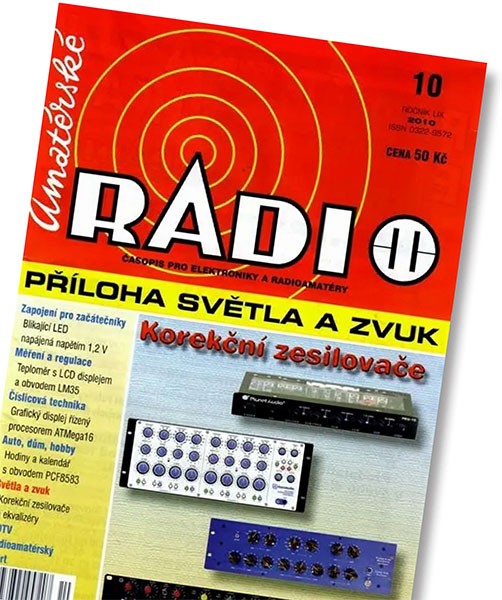
I continued to learn about computers from the magazine Amateur Radio. I liked the description of the Intel 8008 processor. I read through the descriptions of the instructions and dreamed of playing around with such technology. Later, Amateur Radio published instructions for building your own computer based on the U880D processor, which is similar to the Z80. I was in college when I started designing my own construct - the bus, the display controller, and the MHB4116 memory chips. First, I had to load the basic firmware onto the Isostat switches via DMA, then write a loader on the membrane keyboard to load it from a cassette. Later, a classmate burned the firmware onto a 1KB PROM for me - that was a real luxury.
How did you become a programmer?
I originally trained as a low-voltage electrical engineer. I was introduced to electrical engineering by the book "Solim, Me, and Transistors", which I discovered in my father’s library. While still in secondary school, I participated in the Integra 1978 competition in Roznov pod Radhostem, where we soldered an amplifier using an MDA2010. And we received a bag of components. It was amazing - those beautiful integrated circuits and transistors. That’s what made me fall in love with Tesla Roznov, and it led me to go work there as a Robotron computer technician after college.
At school, we only took Fortran lessons. After graduating from university, I encountered a Sharp MZ-821 computer while serving in the military. Those games captivated me. That’s why, after my military service, I bought one of these computers myself and started creating things on it. Mainly in Z80 assembly language, of course. But eventually, I was even more drawn to the Robotron K5120 computer we had at work. It used 8-inch floppy disks and ran the SCPX (a variant of CP/M 2.2) and SIOS (a banking system) operating systems. I disassembled the programs and the system, printed out the listings, and analyzed them in detail. I did the same with the firmware for printers and terminals. I think that period gave me the most experience and knowledge.
Later, we also added Robotron XT and PC-AT computers in Tesla. So I made the switch from CP/M and the Z80 to PCs and x86 processors. Of course, I continued disassembling programs, the DOS system, and the BIOS. I wrote my own programs in assembly language. The main reason was that I saw how slow, bulky, and cumbersome programs written in higher-level languages were. I always told myself - I’d rather put more of my own work into it so that it would be small and fast for users. It’s worth it.
Was it difficult to gain access to the knowledge and tools needed for software development in the late 1980s and early 1990s?
During the socialist era, we did have a copyright law, but it didn’t cover software because it was too new a field. It was considered normal to obtain software illegally. At first, there weren’t many sources for how or where to get software. So we were happy whenever we managed to copy something from someone. The situation was even worse when it came to information. For me, analyzing other people’s programs was a major source of information. I also gathered various bits and pieces of information wherever I could find them. Later on, “Ralf Brown’s Interrupt List” became the best source of information.
One of the first widely used programs you created was DOS Manager in the early 1990s. What problem did it solve, and why did it become so popular?
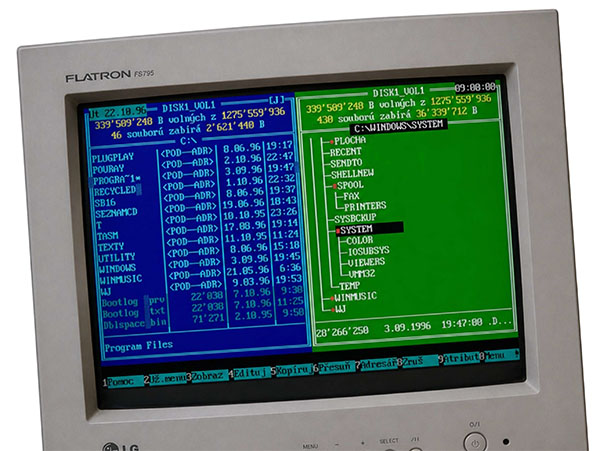
When using a PC, file operations were necessary. At first, I used PC-Shell and Ergo. Then came Norton Commander - finally, a truly pleasant and convenient file manager. After Velvet Revolution, however, a problem arose - there was a lot of talk about software legalization and compliance checks. That led me to the idea of creating my own file manager to replace the "illegal" Norton Commander. I started developing DOS Manager while I was still in Tesla. It began to be used there as a legal file manager.
DOS Manager was the reason I later left Tesla and set out on my entrepreneurial journey. It happened when Josef Kanovsky from Golem asked my boss if he knew anyone who could test their security system, Hradba (Rampart), to see if it could be cracked. And my boss recommended me. That’s how we met. But I disappointed them a bit - at Golem, they wanted to hear that Hradba was impenetrable. I used the DEBUG program, stepped through the protective system's layers, and applied patches that gradually removed those layers. Yes, it was good protection, with plenty of anti-reverse-engineering tricks, but still… And so I left Tesla, and together with Golem, we began offering DOS Manager commercially.
DOS Manager became our flagship product. Its main advantage was that it was small and fast - because it was written in assembly language. We also created a minimalist version called Mikroman, which included only the most basic functions. It was originally intended to serve as a demo for DOS Manager, but it found its own niche, and people reportedly still use it on their retro machines even today.
Later, a completely new version of DOS Manager, v2.0, was released, which offered many more features, such as a calendar, calculator, database. Around that time, Windows 95 was introduced. DOS Manager 2 was the only file manager of its time to support long file names under Windows 95. Unfortunately, with the rise of Windows, file managers ceased to be of interest to people and gradually fell out of favor.
The first video game of yours that I came across was the cult classic Vlak (Train). Was that the first video game you ever programmed?
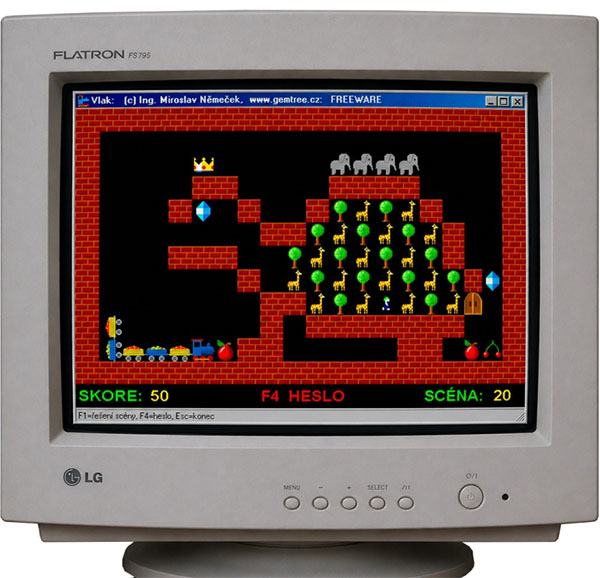
The game Vlak was preceded by many utilities and little games that helped me learn how to work with PC graphics. They were mostly small experiments, such as the game Privatization, which I created using my own programming tool, Animator. Vlak started out as just a little game - a variation on Snake. But somehow it gradually grew into 50 scenes. And for some reason, people liked it; to this day, I have no idea why.
Which of your programmed games is your favorite? I really enjoyed the game Ants!
I have to admit that I’ve actually never really enjoyed my own games. But I guess other game designers feel the same way. At first, there’s always that thought: "It’ll be amazing once I finish this!" And then, once the program is finished, you nod your head, and at that moment, you lose interest. That’s why, in "Train" and other games, I had to create macros that play through the scenes, because I didn’t want to go through them manually anymore. When I port "Train" to a different environment, I run the macros, and the automated system verifies that all the scenes are functional.
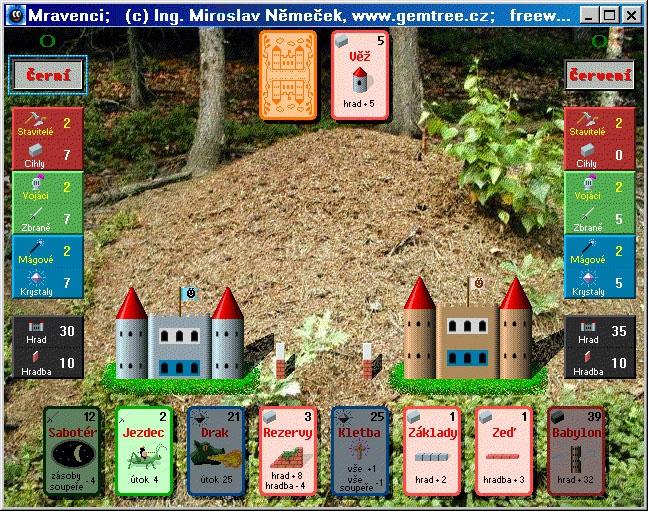
Ants is a bit of a misstep, because it wasn’t exactly my idea. Conceptually, it’s based on the game ArcoMage, which I came across in Might and Magic 7. The premise is similar, but the graphics, cards, and scoring are different. And above all, it was originally meant to be a game demonstrating the capabilities of the Petr programming tool.
What's your relationship with video games? Do you play games, or have you played them in the past?
I used to play games, and I still play them from time to time. My all-time favorite is Might and Magic 6. Thirty years ago, that game inspired me to create a 3D engine for Petr, which became one of Petr’s most significant features, and I still come back to it.
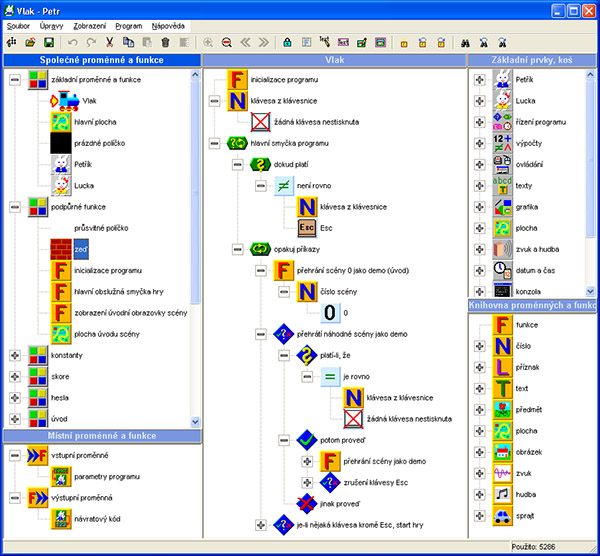
You just mentioned your programming tool, Petr (Peter). What made Petr interesting back then?
I originally created Petr for my son because he wanted to try his hand at programming. The beginner-friendly programming tools of that time that we tried were unusable. So I created a graphical programming tool suitable even for the youngest children. My daughter also used Petr to program. Compared to other similar tools, Petr’s main advantages were that it was easy to use, had powerful features, and was very fast. Internally, it’s an interpreter, yet the code executes very quickly.
Can the Petr still offer something to people interested in programming today, or would you recommend other, more modern engines?
Gemtree Petr is available today as open-source freeware. However, these days it has issues with antivirus programs. Internally, the program’s EXE file contains a program interpreter to which the source code is attached in binary form. The advantage of this is that every EXE program created in Petr is saved as an executable and can also be opened in an editor and edited. Unfortunately, antivirus programs don’t like this format - they interpret it as a sign of a virus and flag programs created in Petr as potentially dangerous. That’s probably the main reason why I no longer recommend using Petr today. There are now many other tools available that may be easier to use.
In the past, you even tried your hand at developing your own operating system. What prompted you to do that?
I have this unpleasant tendency: whenever I don’t like something, I feel compelled to create my own version exactly the way I want it. I didn’t like the concept behind Windows. But Linux disappointed me even more. I wanted to create something that would be sophisticated, fast, and overall perfect. But it took me a while to realize that something like that would take me decades - and by then it would already be obsolete. That’s how the first rough draft of the Litos system was created in assembly language; it did "something," but it was still a long way from being usable. However, I still use some of the ideas from Litos to this day - the time-measurement system, a calendar spanning 60,000 years, and a fast tile-based memory allocator.
I recently discovered the PicoPad mini game console. Is it more about programming or hardware tinkering?
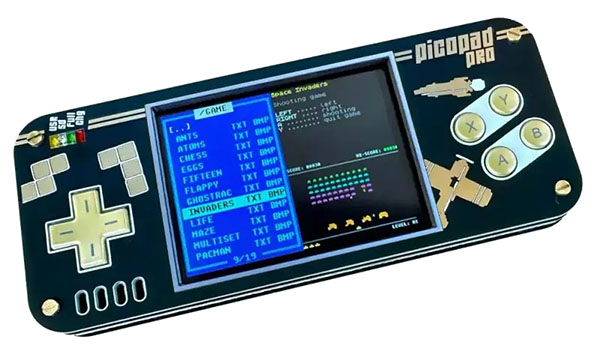
PicoPad came about because I was intrigued by the Raspberry Pico module. It seemed very powerful and easy to use, yet at the time there was almost no software available for it. The main focus of the project was writing an SDK library for the Pico, which then served as the basis for creating sample programs for PicoPad, including ports of my older games such as Vlak and Mravenci. I really had a lot of fun working on the SDK. It could be said that it encapsulates my work from past years. Of particular interest are, for example, the double and float libraries for the RP2350, which I developed based on my experience with the ZX81 - specifically, the use of Chebyshev polynomials for function calculations.
Who is the PicoPad suitable for?
The PicoPad has become popular mainly because of its hardware design - a small, pocket-sized console with a small display and a battery that can be easily programmed. The PicoPad can be programmed either in C using my SDK library or in Python. Programmers have full access to the console’s hardware, along with good documentation and many examples. People use it to write their own games as well as to control peripherals.
Is the PicoPad project still active? Some of the tutorial sections on the picopad.cz website have been unavailable for quite some time.
These days, PicoPad has fallen a bit by the wayside - people played with it for a while and then set it aside. Some users still use it, but that initial enthusiasm has faded somewhat. That’s also why I’m now working in other areas. But we’re delighted when we come across PicoPad clones, for example in Japan.
Has your approach to programming changed at all over the years? What do you think about artificial intelligence and the "vibe coding" trend?
Everything evolves. In the beginning, I programmed exclusively in assembly language. Over time, I switched to C and C++. Today, C compilers are so efficient that it’s hard for assembly to compete with them. And most importantly, programs written in C can be ported to other environments. So today, I write 90% of my code in C/C++ and only some critical parts in assembly (currently mainly ARM and RISC-V). Lately, I’ve really taken to using AI. It’s a huge help with my work. My favorite is Copilot. We discuss problems, it advises me on approaches, and it checks my code. It’s an amazing way to streamline my work.
What tools and resources would you recommend to someone who wants to get started with programming these days?
It’s hard to recommend anything when the whole world is programming in Python or using large IDE environments these days. I used to use various environments, but over time I switched to just the most basic GCC compiler run from the command line. I edit my programs using FAR Manager. And I have to say, I’ve been so relieved ever since I got rid of all that extra baggage that was just weighing me down. This is the simplest way - you write the program as plain text, compile it, upload it to the microchip, and it works. No struggling with buggy third-party environments or operating systems - the program does exactly what you write.
Which of your creations - whether software or hardware - are you most proud of?
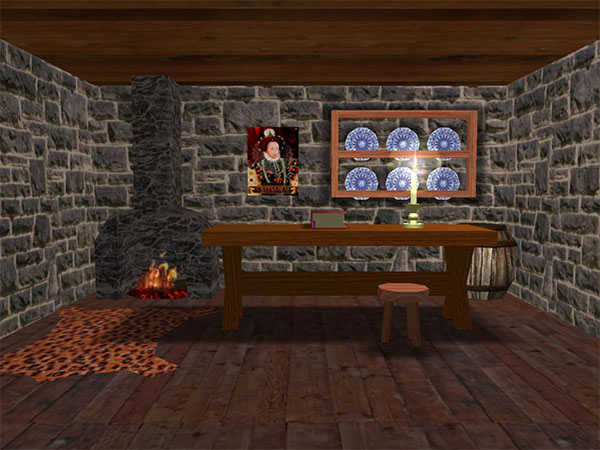
As far as games go, I’ve always valued my game "Thirteen Ghosts" the most. I created it in Petr for the Becherovka competition. It was the game I put the most effort into. I fine-tuned the textures and scenes to make them truly perfect and to ensure the program was small and efficient. That’s why I was a little disappointed by the lack of interest in the game. But that’s always the way it is with everything - popularity usually doesn’t match the author’s expectations; take, for example, the game Vlak. Otherwise, though, I find myself looking forward most to the things that are yet to come and “will be amazing.” Meanwhile, the things I’ve already done seem less interesting to me.
What do you think is the appeal of the game "Thirteen Ghosts"?
What I like most about this game is the graphics. Sure, there are games with high-quality graphics, but here they’ve managed to reduce the textures to an absolute minimum so that the program is small yet still visually appealing - something that multitextures, for example, helped achieve. There are 13 puzzles, each from a completely different category. Some are really tough. There’s even one scene with a train simulator - I spent two days coming up with the puzzle for it, and it’s the only scene where I included a hint, because I figured it would be difficult for players to solve. So far, I haven’t heard of anyone who’s solved this scene without the hint.
Are you enjoying retirement, or are you working on another interesting project?
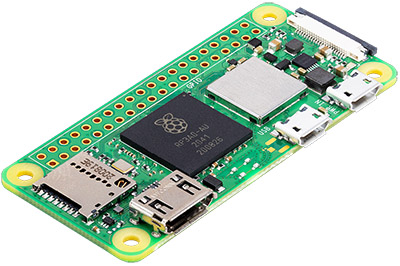
I left my job five years early and am now living off my savings for one reason only - so I can finally create things the way I want. That’s why PicoPad and its SDK library were created. After PicoPad came the super-cheap CH32V processors, the CH32LibSDK library, and small, inexpensive game consoles powered by these processors. And now I have yet another new hobby - Raspberry Pi modules, for which I’m writing a bare-metal SDK library. Primarily the Zero 2W module. Although this module is very powerful, it could only be used with Linux, which severely limits a programmer’s options. In a bare-metal environment, you can create amazing things with it. I’m completely captivated by this field right now and am devoting all my time to it. But of course, there are still many other projects on my to-do list that I’d like to tackle someday, if my remaining years allow - such as a powerful graphing calculator with extreme precision.
What are your plans for the Zero 2W module?
First and foremost, it’s a small desktop computer for gaming and DIY projects. That in itself wouldn’t be so unusual - Raspbian, for example, is available. The key point is that it’s bare-metal. This means the computer can run without an operating system, much like other microchips. After powering on, a window appears within 2 seconds allowing you to select programs from the SD card to run. The programs run very quickly because the processor isn’t burdened by system multitasking - it has full access to all the hardware. This transforms a slow, sluggish device into a powerful computer. Programming is truly enjoyable here, as the Zero 2 provides ample memory and processing power. An ideal device for DIY enthusiasts and tinkerers. It takes us back a bit to the days of DOS, when we also ran just one program on a PC and that was enough for us. And here we have many times more performance and memory at our disposal than we did back then.
You emphasize optimization and efficiency. It seems to me that those aren't really in vogue these days.
That's right - these days, nobody worries about optimization anymore, and they often use only slow scripting languages because they rely on hardware performance; so a powerful PC today can handle the same tasks as a PC that used to be considered underpowered.
Isn't it more complicated for a programmer to handle everything from an app without an OS?
An SDK is available for programmers that handles hardware-related issues. When the SDK is well-written, programming is just as difficult for the programmer as writing code directly for the system. More precisely - it’s easier. I’ve set up the SDK for the Pi so that the API is mostly compatible with the API for the PicoPad SDK, making it relatively easy to port programs from the PicoPad to the Zero 2. The main differences are that the Pi has more memory, a faster processor, and higher screen resolution (e.g., even Full HD). Programs run quite fast here. The Pi also has a hardware accelerator and OpenGL available - I haven’t implemented these features yet because they’ll be more complex. Once I do, games will run really fast. Right now, I’m implementing everything using only 2D software graphics, but even so, it’s a huge improvement over the PicoPad.
Once OpenGL is up and running here, 3D games should probably run about as well as they do on the operating system, since the hardware handles the acceleration. The speed boost is more noticeable with other programs that have to run in software - such as emulators; those should run quite fast here. So I’m curious to see how fast the NES and GameBoy emulators I had on the PicoPad will run once I port them here. Finally, GBC programs larger than 2MB will also run here, which couldn’t run on the PicoPad due to its limited Flash memory.
Are you planning to release a kit similar to the PicoPad?
Unfortunately, I don't have the means to produce hardware - I just develop software and tinker with prototypes so I can develop software on them. Whether any hardware - such as a kit - will be released is, unfortunately, out of my hands.
You also mentioned other small, inexpensive game consoles. Where can you find them, and how do they differ from the PicoPad?
These consoles use Chinese CH32V processors. What makes them interesting is that they are extremely inexpensive. The cheapest models are available for $0.1. They are similar to STM32 processors, but unlike those, they use the RISC-V instruction set. They are less powerful than the processor in the PicoPad, so given their price, they are better suited for very small devices and toys, where they can replace more expensive integrated circuits. I’ve used them to build a few simple, small game consoles and calculators. These are more like mini-toys than full-fledged game consoles. The downside of the CH32V processors, however, is that they’re only available on the Chinese website AliExpress. It would be better if someone here offered them as kits. Unfortunately, that’s still under discussion. For now, there are only prototypes of the devices and detailed documentation for them. Interested parties must source the hardware themselves.
Where can people interested in your freeware download your creations?
I have my own personal website, https://www.breatharian.eu/Panda38, where I post everything I create. In addition, I'm mainly active on X (Twitter) as NemecekPanda38.
Sometimes people ask me why my website says it’s being shut down. People don’t realize that information on the internet has a limited lifespan - and so do people. I’m 63 years old now, so the end of my life may be in sight. When I’m gone, my website will disappear. That’s why I’m pointing this out with a warning that the site may be taken down - so that anyone interested can download the information they want in time.
Thank you so much for your time, and I wish you many more successful projects!
For more information, click here: